
Raw Syrup
Controlled reduction of color load within refinery streams.
Home / Applications / Sugar Refining
Application Area
Adsorptive reduction of color-forming organics and trace impurities in sugar syrups, supporting clarification and purification stages.
Role Of Activated Carbon
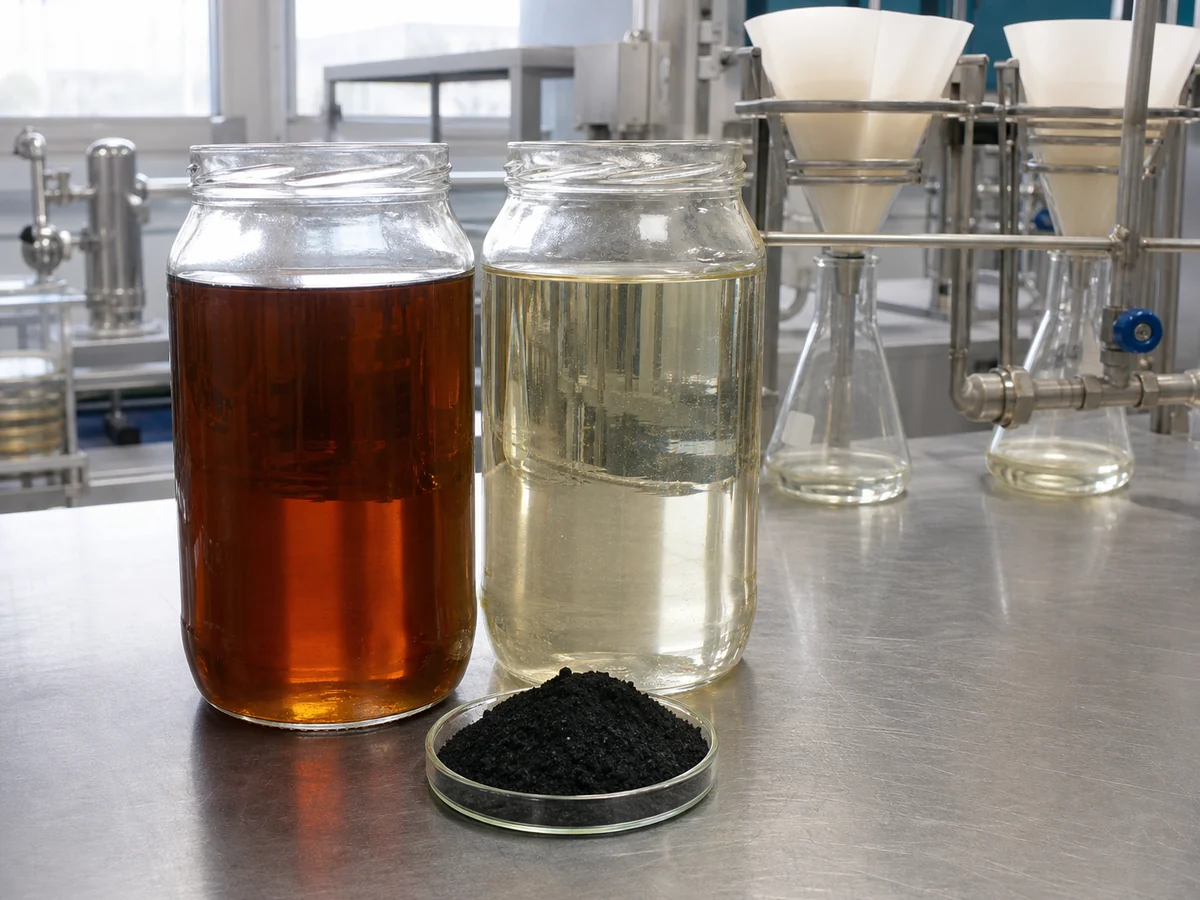
During controlled contact with syrup, powdered activated carbon adsorbs high-molecular-weight color bodies and selected trace impurities. The carbon is then removed with suitable filtration equipment.
Syrup Brix, temperature, pH and initial color affect adsorption and filtration behavior. The correct dose and contact time are established through laboratory trials.
Applications
Controlled reduction of color load within refinery streams.
Polishing to support final-product clarity and appearance.
Batch contact and filtration for a defined color specification.
Suitable Form
A fixed-bed option that can be evaluated for continuous columns or final polishing lines.
View Granular Product →For rapid, uniform contact with syrup followed by filter press or suitable filtration.
View Powdered Product →Dosage, contact time and filterability should be evaluated with the actual syrup sample.
Share your process conditions; our technical team will help define the right form and test route.
FAQs
Colour-forming organic compounds in the syrup are captured in the carbon pores, yielding clear, standard-colour sugar.
Methylene blue adsorption indicates decolourisation capacity. AKARBON 1000 offers the highest performance at >250 mg/g.