
Home / Hazelnut Shell Activated Carbon
Hazelnut Shell
Activated Carbon
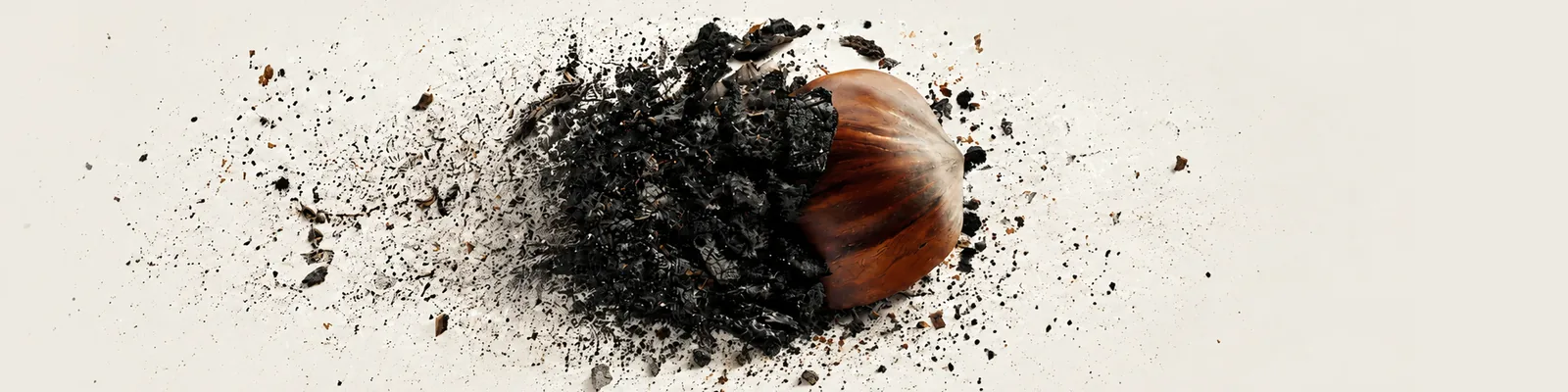
The 300,000–400,000 tons of hazelnut shells Türkiye burns every year are, for us, the starting point of a high-performance adsorbent. Compared with the imported alternative: hazelnut shell vs coconut shell.
An Indigenous Alternative To Coconut Shell.
In the global market, activated carbon is most associated with coconut shell. We offer it from Türkiye's most abundant fruit, the hazelnut shell, with higher pore quality and a far shorter supply chain.
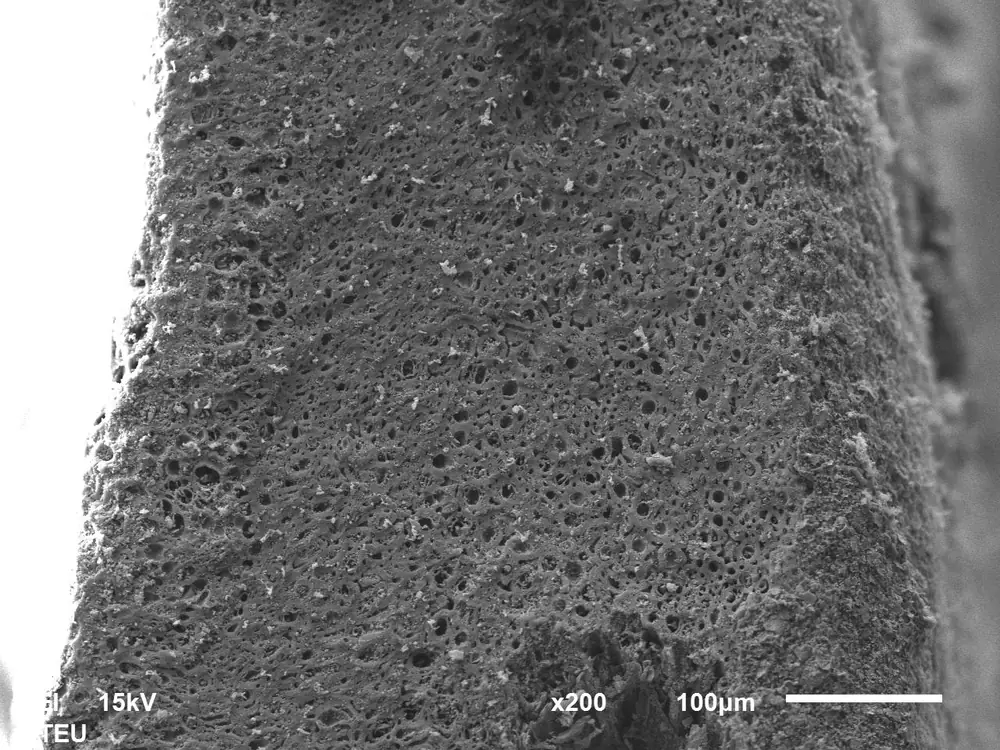
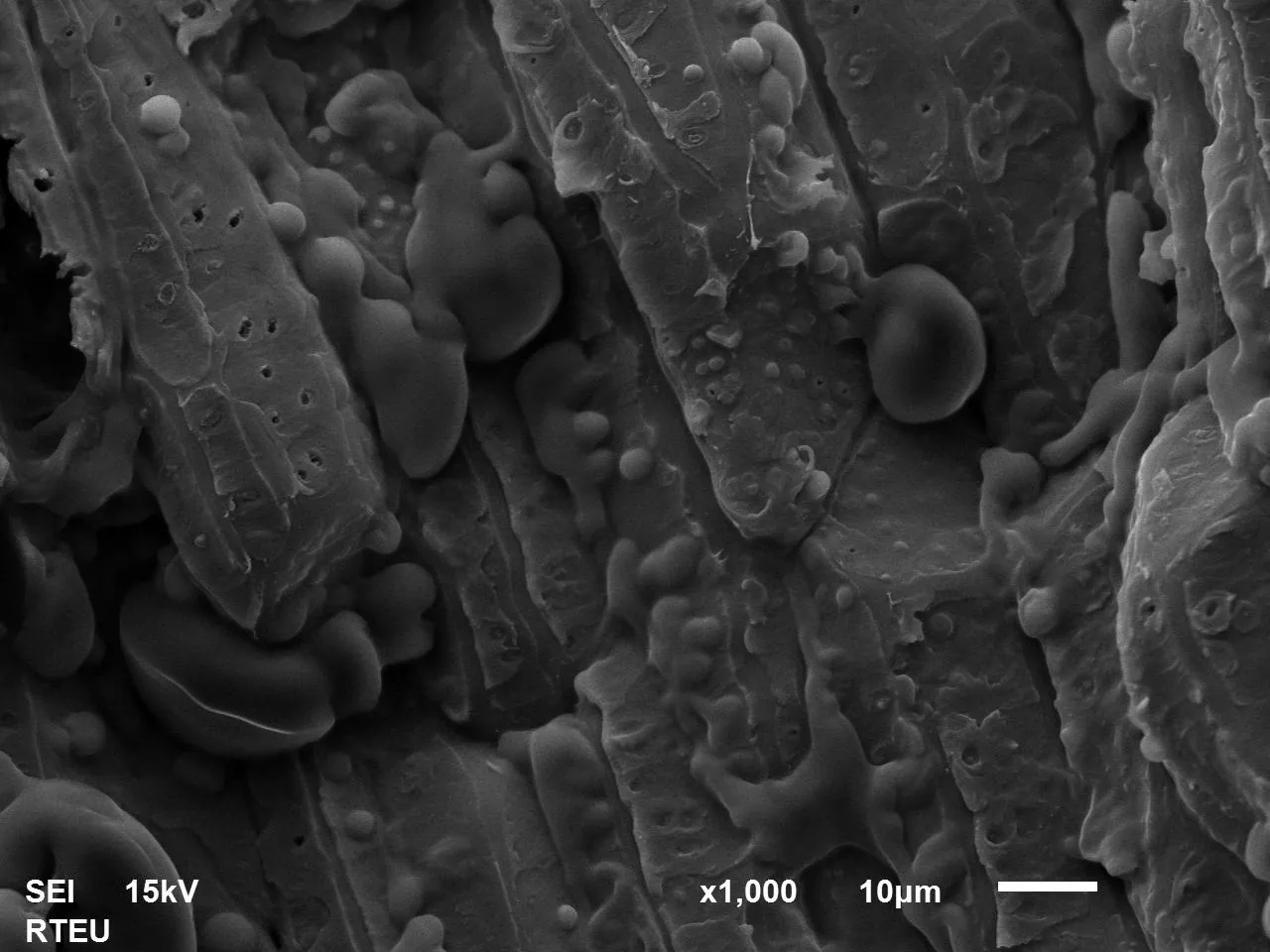
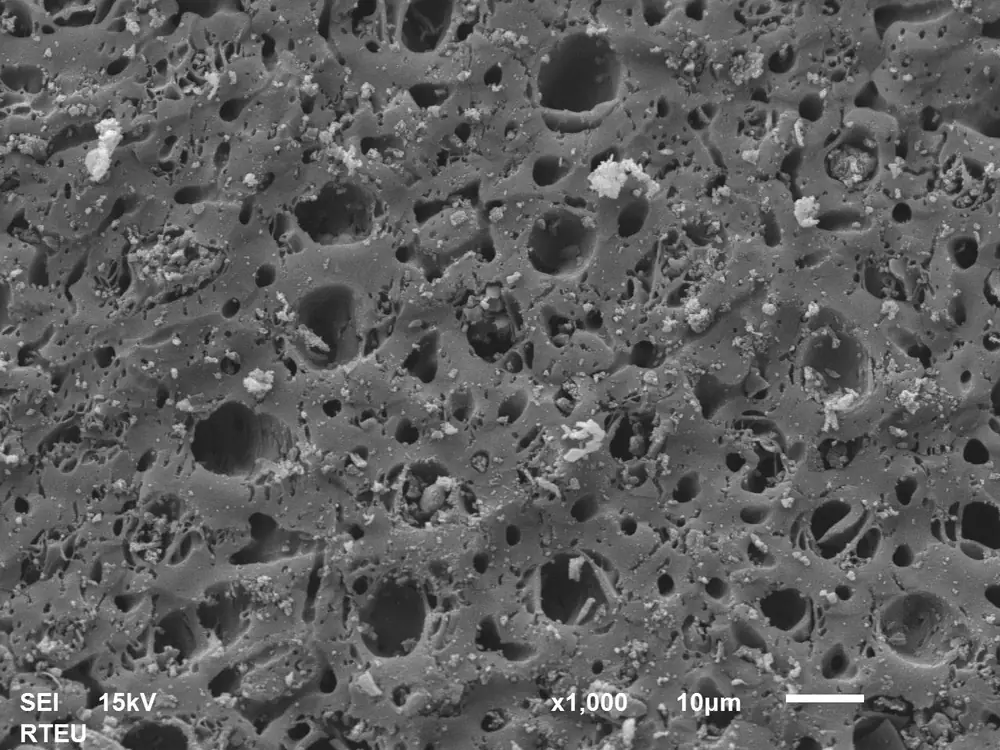
SEM · Scanning Electron Microscope
Hazelnut Shell And Activated Carbon Side By Side.
On the left is normal hazelnut shell; on the right is activated carbon made from hazelnut shells. The same raw material becomes a much more open and dense pore network after activation.

Raw material
Why hazelnut shell?
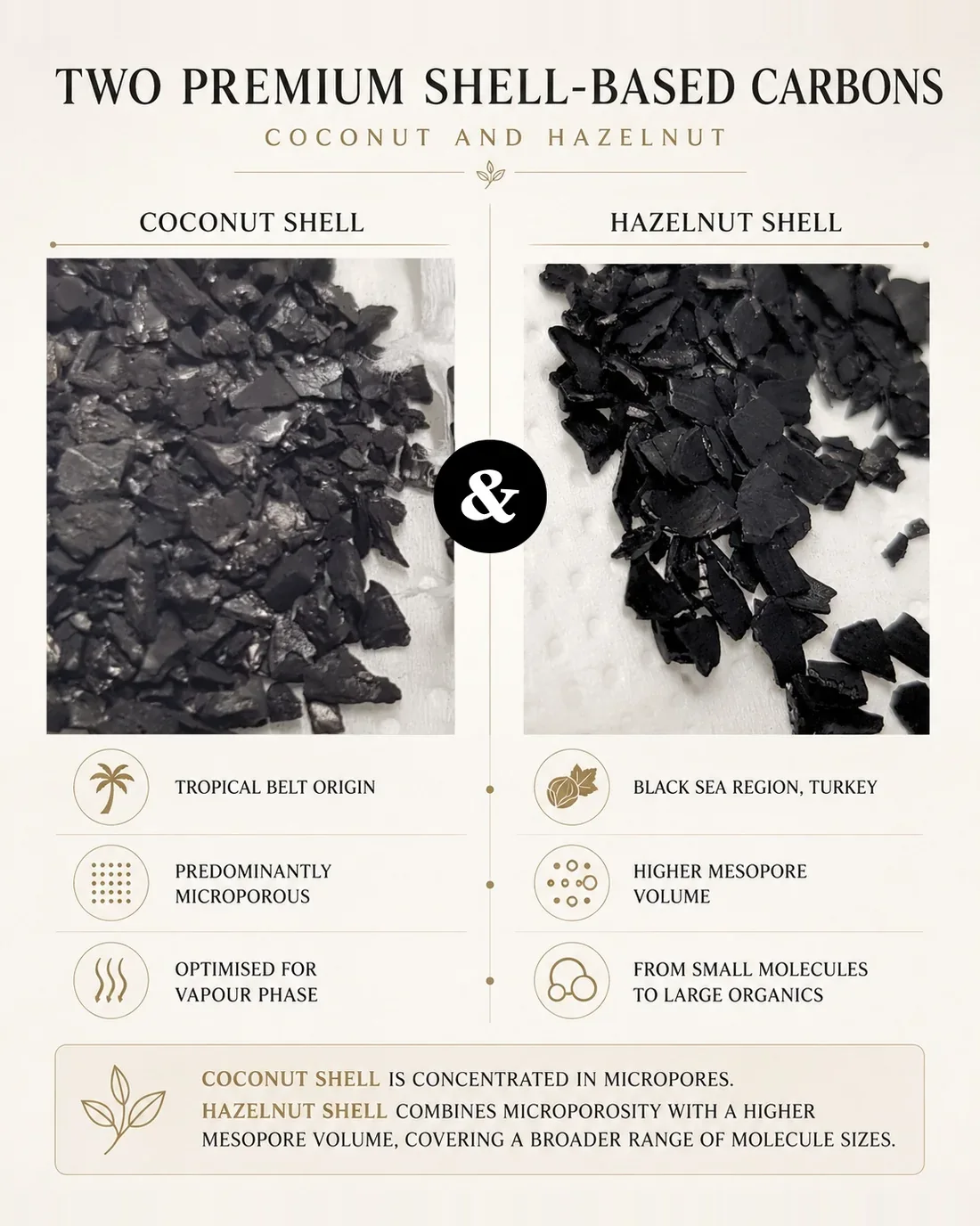
The quality of activated carbon begins with its raw material. With a high lignin ratio and dense cell walls — much like coconut shell — the hazelnut shell yields a hard, durable carbon. Two things set it apart. First, the pore structure: coconut shell is almost entirely microporous, whereas hazelnut shell adds a usable network of meso- and macropores on top of that — the BJH and DFT measurements below put numbers on the gap. Second, distance: our raw material is not shipped in from the far side of Asia; it piles up along the Black Sea coast after every harvest.
| Raw material | 100% hazelnut shell (Black Sea) |
|---|---|
| Process | Indirectly heated stainless steel kiln |
| Patent | Turkish Patent NO: 2012/02871 B |
| Capacity | 100 tons/month |
| Forms | Granular 0–10 mm · Powder <150 µm |
| Testing | ASTM standards, per batch |
Independent lab · BJH
Hard As Shell, Open As Wood.
Not all pore volume does the same job. Small pores hold tightly. Larger ones carry molecules inward — and catch the ones too big for anywhere else.
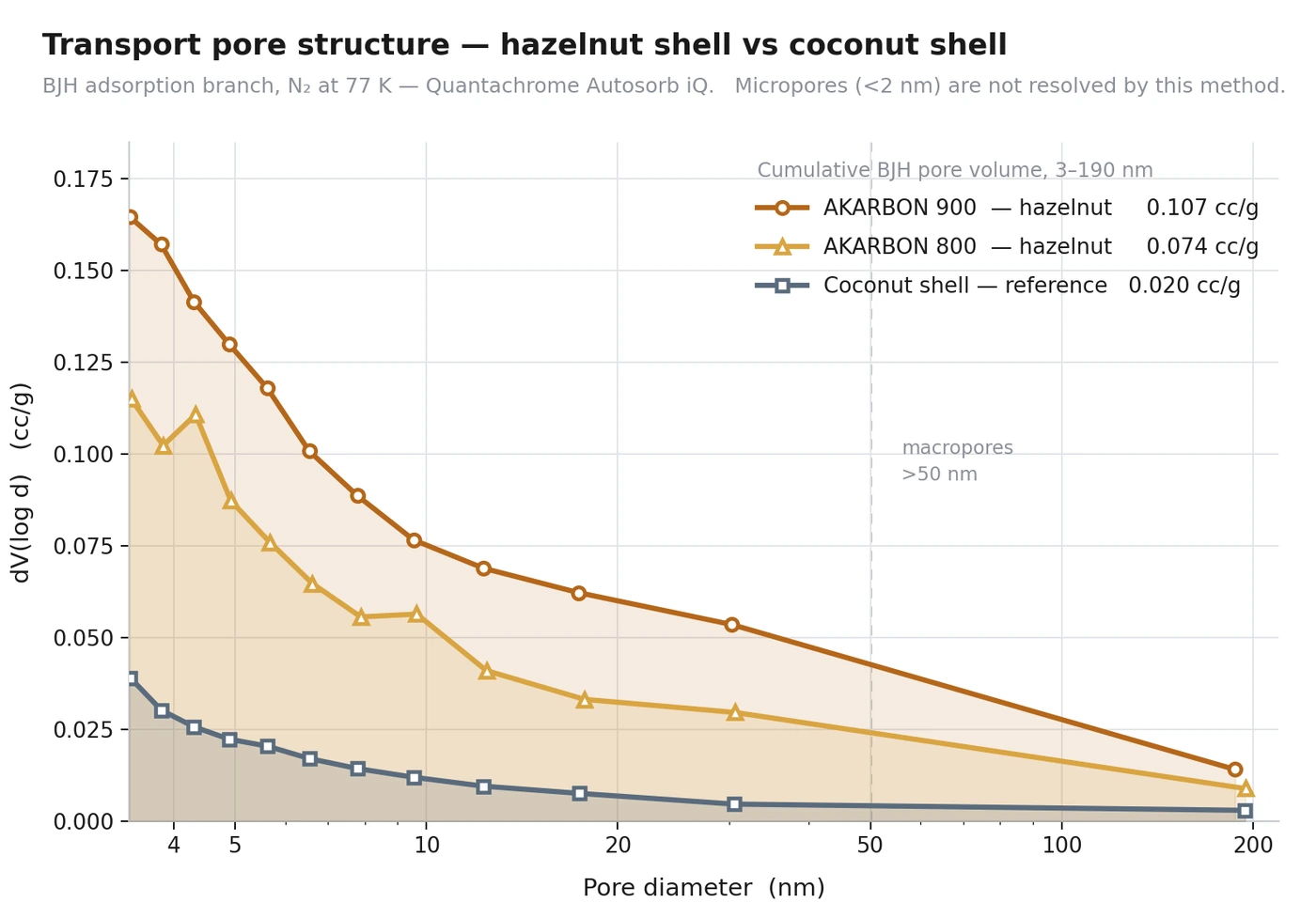
We had three activated carbons analysed by an independent lab: two of our hazelnut shell grades, and a coconut shell carbon widely used for water treatment in the Turkish market, as a reference.
| Sample | Transport pore volume · 3–190 nm |
|---|---|
| AKARBON 900 | 0.107 cc/g |
| AKARBON 800 | 0.074 cc/g |
| Coconut shell (reference) | 0.020 cc/g |
Five times the difference between our AKARBON900 grade and the coconut sample.
This matters most in water: molecules reach the inner surface by diffusion, and diffusion is slow. A pore with no clear route in stays largely unused.
And it matters most of all for contaminants like PFAS, which are measured in nanograms per litre, while the natural organic matter in the same water is measured in milligrams. There is vastly more competing material than target, and that organic matter settles at the entrances of the smallest pores and closes them off.
The combination is what we are after: a hard, shell-based granule with an unusually open pore structure.
This is pore structure, not performance data.
Independent lab · DFT
Which Pore, For Which Molecule?
The measurement above showed transport pores (BJH, 3–190 nm). This time the same three carbons under DFT analysis, which reaches down into the micropores too: 0.71 to 36 nm.
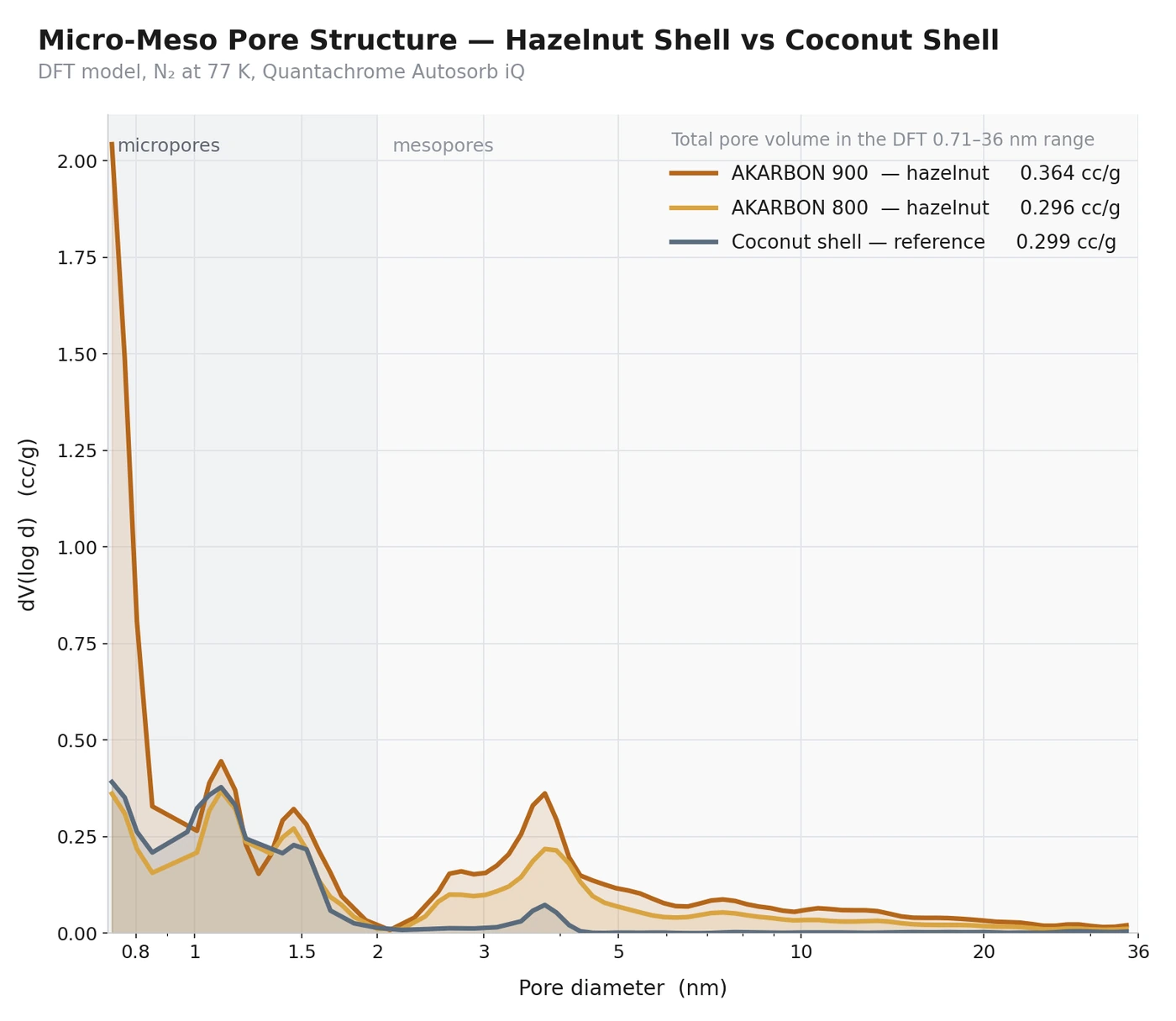
Activated carbon works best when the pore is roughly 1.3 to 1.8 times the width of the molecule you want to remove. Much narrower and the molecule cannot enter. So removing something from water is a matching problem:
| Contaminant | Size | Pore diameter needed to capture it |
|---|---|---|
| Chlorine | 0.3 nm | 0.4–0.5 nm |
| Chloroform and other THMs | 0.5 nm | 0.7–0.9 nm |
| Geosmin, MIB (taste and odour) | 0.6 nm | 0.8–1.1 nm |
| PFOA, PFOS | 0.8–1.0 nm | 1.0–1.8 nm |
| Pesticides, pharmaceutical residues | 0.9–1.5 nm | 1.2–2.7 nm |
| Natural organic matter | 1–10 nm | mesopores |
The coconut shell sample holds 0.208 of its 0.299 cc/g below 0.71 nm. Good for chlorine, below the useful range for most of the list above. And in real water, even chlorine has to get there first.
Our AKARBON900 grade spreads its volume across four bands. It dominates in two of them, 0.75 nm and 3.7 nm. Total pore volume in the range up to 36 nm is 0.364 cc/g against 0.299 for the coconut sample, same instrument, same method.
Then there is the part no pore size chart shows. PFAS is regulated at nanogram-per-litre levels, and taste and odour compounds matter at trace concentrations too. Meanwhile the natural organic matter in the same source water can be present at milligram-per-litre levels — a million times more.
Micropores are not free-standing holes. They are openings in the walls of the larger pores. Organic matter is far too big to enter one: it adsorbs onto those walls and covers the openings. It never gets in, and now nothing else does either. Published column studies have found this hits highly microporous carbons harder than carbons with an open structure.
That is what the larger pores are for. They are the route in — and they take up the organic matter that would otherwise seal the small pores shut.
This is pore structure, not performance data.
Feedstock comparison
All Activated Carbon. Not All The Same.
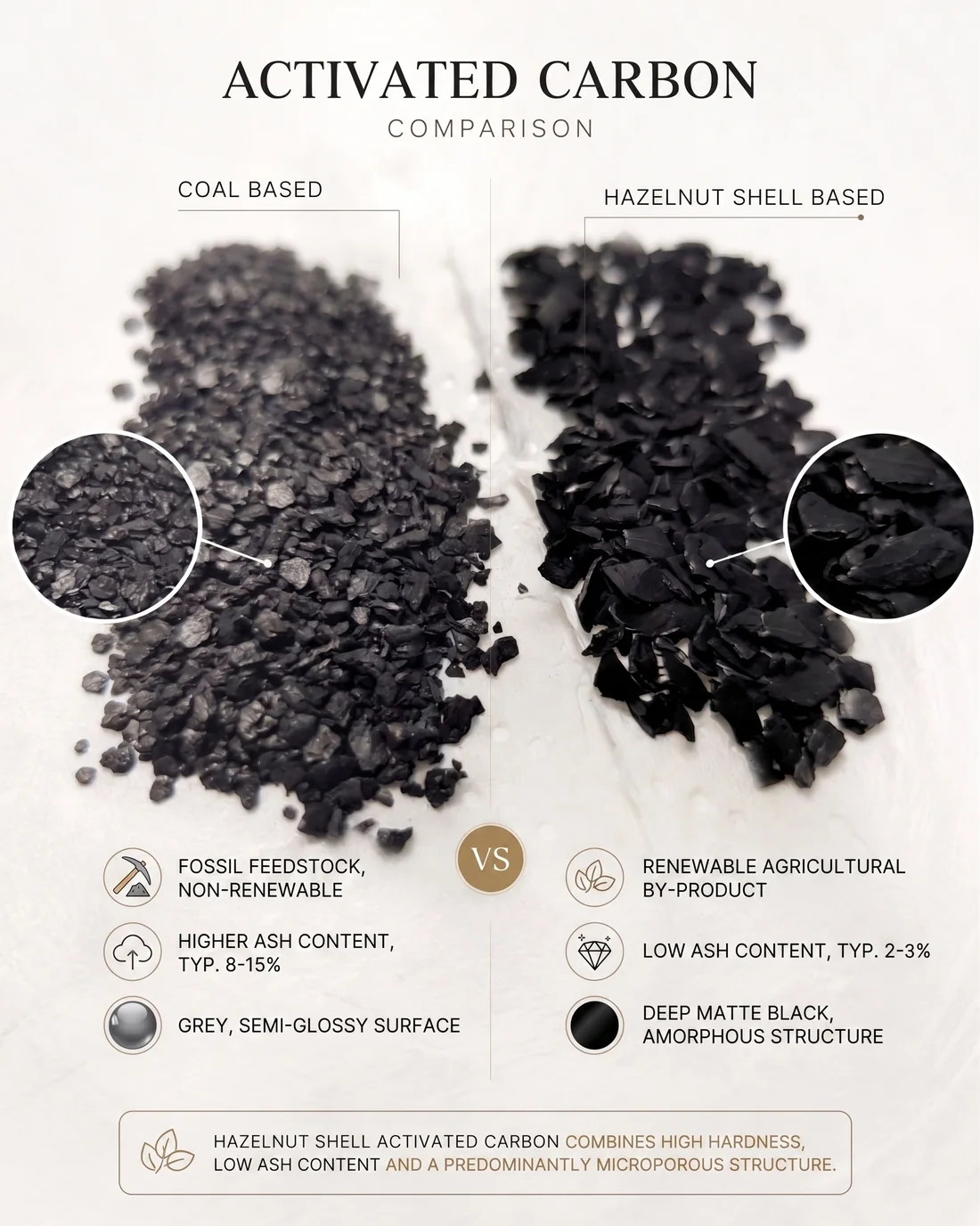
The raw material decides everything: the hardness of the granule, the ash it carries, how its pores are distributed and which molecules it can hold. Two comparisons — first coal against hazelnut shell, then two shell-based carbons.
Product 01
Granular Activated Carbon
Produced in the 0–10 mm range; sized to your project's requirement with our crusher. Long service life in fixed-bed filter systems.
| Size range | 0 – 10 mm |
|---|---|
| Sizing | To required size, via crusher |
| Raw material | 100% hazelnut shell |
| Applications | Drinking water treatment, water treatment systems, air purification, odor removal |
 Granular activated carbon · 0–10 mm
 Powdered activated carbon · <150 µm
Product 02
Powdered Activated Carbon
A particle size below 150 microns maximizes contact area with the solution: fast adsorption, short contact time.
| Particle size | < 150 µm |
|---|---|
| Raw material | 100% hazelnut shell |
| Surface area | High internal surface area |
| Applications | Water and air treatment, food and beverage processes, industrial purification, medical applications |
The same assurance in every form
Whichever Form You Choose: The Same Patented Process, The Same Laboratory Control.
FAQ
About hazelnut shell activated carbon
Can activated carbon be made from hazelnut shells?
Yes. With its high lignin content and dense cell structure, the hazelnut shell is an ideal raw material for activated carbon. After carbonisation and steam activation it yields a hard, durable carbon with a more open pore network than coconut-shell carbon: alongside micropores it carries usable meso- and macropores.
What is the advantage?
It is produced from an indigenous, sustainable waste material — a logistics and currency advantage over imported coconut-based carbons. Its hard structure keeps attrition loss low, with an iodine number around 1000 mg/g.
Why is Akarbon's process different?
In our indirectly heated stainless steel kiln the flame never touches the product, and with no brick lining there is no mineral contamination. The process is registered under Turkish Patent NO: 2012/02871 B.
For international buyers
Specify the right activated carbon for your process.
Akarbon manufactures activated carbon from hazelnut shells in Düzce, Turkey. Start with the AKARBON 800, 900 and 1000 technical data sheets, then discuss the form and particle size your process needs.
- Tell us the application, contaminants to remove and required treatment performance.
- Specify granular or powdered carbon, particle size and required test values.
- Include the requested quantity, delivery country and preferred schedule.
- List any required documentation, packaging or certification for confirmation with our team.
For fixed-bed filtration, review granular activated carbon (GAC). For dosing and subsequent separation, review powdered activated carbon (PAC). Final selection depends on your process conditions and testing.
Not Sure Which Form Suits You?
Tell us about your application; we'll get back within 2 hours.